

Why Mortar Joints Fail Faster in Southwestern PA
Freeze and thaw is the whole story. A mortar joint holds water the way a sponge does. When the temperature crosses freezing, that water expands and pries at the joint from the inside. Pittsburgh does not have one long deep freeze. It has a winter of repeated crossings, and each cycle takes a little more mortar.
The damage is not evenly distributed, which is useful to know when you are looking at your own chimney. The joints that go first are almost always on the north and west faces, where sun never dries the masonry and the prevailing weather drives rain into the wall. The top few courses fail before the rest because they are the most exposed and because water sheeting off a cracked crown runs directly over them.
Age plays a part too. Chimneys built before roughly the 1930s were laid with soft lime based mortar. Repointing those with a modern high cement mortar is a genuine mistake. The hard mortar will not move with the soft brick, so the brick face takes the stress and spalls instead. Matching the mortar to the masonry is part of the job, not an upgrade.
When Tuckpointing Is Enough and When It Is Not
Repointing restores joints. It does not straighten a leaning chimney, replace a spalled brick face or fix a structural crack running through multiple courses. Part of what an estimate buys you is an honest read on which category your chimney is in.
| What you are seeing | What it usually calls for |
|---|---|
| Mortar receded, sandy, or crumbling under a key, brick faces sound | Tuckpointing and repointing |
| Isolated cracked joints on one exposed elevation | Partial repointing of that face |
| Brick faces flaking, delaminating or popping off | Brick replacement in those areas, then repointing |
| Cracked or missing crown with joints failing beneath it | Crown repair or rebuild first, then repointing |
| Stair step cracking through brick and joints together | Structural evaluation before any pointing work |
| Chimney leaning, bowing or out of plumb | Partial or full rebuild, not a pointing repair |
| Top courses loose or shifting by hand | Take down and relay the affected courses |
Most chimneys we look at land in the first two rows. The ones that do not are usually chimneys where the crown failed years ago and nobody noticed, which is the argument for an annual look.
How We Approach a Tuckpointing Job
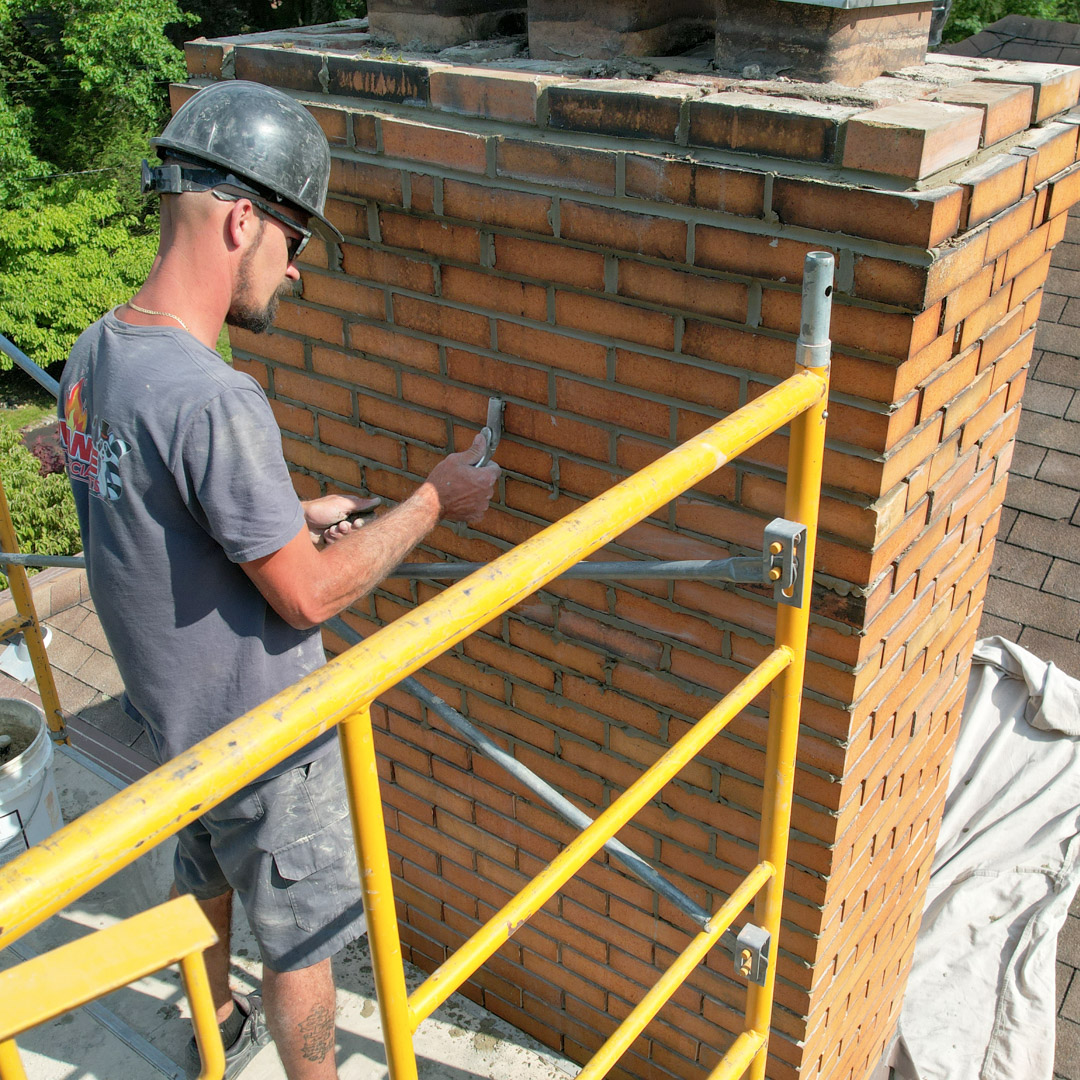
Every job starts with a chimney inspection rather than a quote from the driveway. We need to see the crown, the cap, the flashing and all four faces of the chimney before anyone can tell you what the joints need, because a chimney with failing mortar and a cracked crown is a different job from a chimney with failing mortar alone.
From there the work is methodical. Old mortar is cut out to depth with grinders and hand tools, joints are brushed and dampened so the new mortar does not dry too fast, fresh mortar is mixed to match the existing in both strength and color, and each joint is packed in layers and tooled to the same profile as the rest of the chimney. Surrounding roofing and siding are protected before any cutting starts.
We work across greater Pittsburgh and southwestern Pennsylvania, including Washington, Uniontown, Bethel Park, Upper St Clair, McMurray, Mt. Lebanon, Monroeville, Murrysville, Greensburg, Moon Township, Wexford, Cranberry Township, Glenshaw and West Newton, and across the line into Morgantown and the surrounding West Virginia communities.
When to Schedule and What Happens After
Mortar needs temperatures above freezing to cure and it needs to stay damp while it does, which puts the season for this work from spring through early fall in this region. Repointing done in cold weather risks a joint that never reaches full strength and comes apart the following winter.
After the joints have cured, a vapor permeable water repellent on the masonry is what protects the work. It lines the pores of the brick and the new mortar so liquid water runs off while vapor still escapes. Skipping it means the new joints begin the same slow saturation cycle that destroyed the old ones.
We also look at the cap, the crown and the flashing at the same visit. Repointing a chimney while leaving an open crown above it is repairing the symptom and leaving the source.
Ready to Get Started?
Advance Chimney Sweeps, Inc. has served greater Pittsburgh and southwestern Pennsylvania for thirty years. Owner Michael Schock brings thirty one years in the trade. We hold an A+ rating from the Better Business Bureau with more than 500 Google reviews averaging 4.8 stars, won the 2022 BBB Torch Award for Ethics in Pennsylvania, and belong to the National Chimney Sweep Guild and the Pennsylvania Guild of Professional Chimney Sweeps.
We are licensed in Pennsylvania under PA34561 and in West Virginia under WV041543. Our office is at 1010 Franklin Dr., Suite 1A, Smock, PA 15480, open Monday through Friday, 8am to 5pm.
Call Advance Chimney Sweeps at 724-439-3266 for a free estimate.