
How a Water Repellent Actually Works
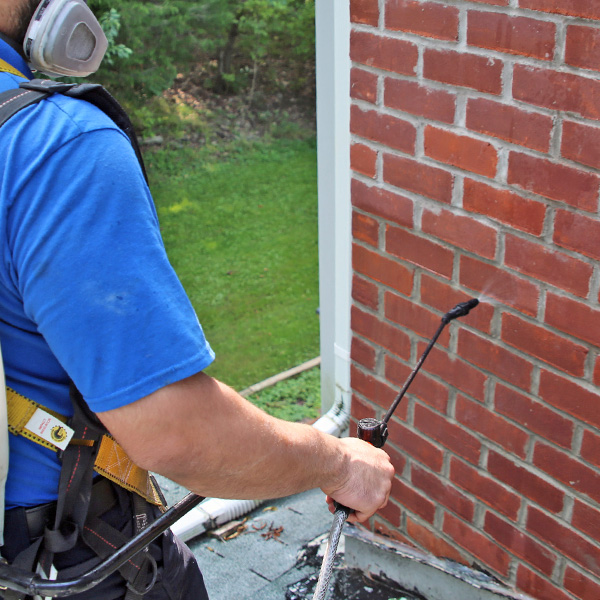
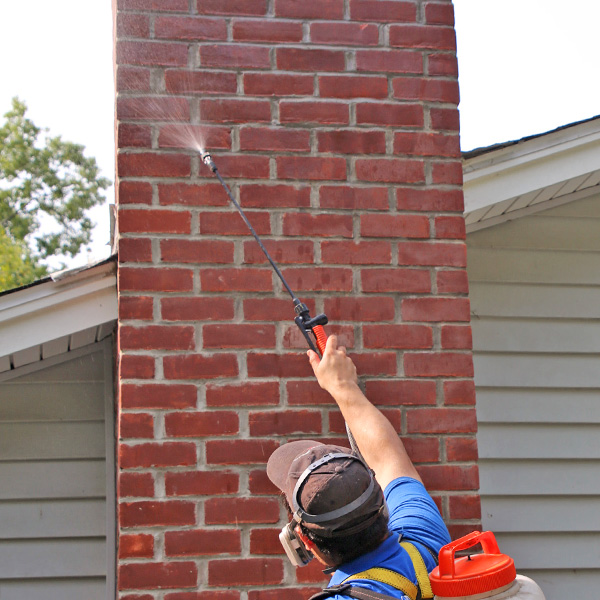
The products we use are vapor permeable siloxane and silane based repellents formulated for masonry. They soak into the brick and the mortar and line the pores rather than bridging across them. Liquid water beads and runs off the face of the chimney. Water vapor already inside the wall keeps moving out.
That second half is the part that matters and the part most homeowners never hear about. A chimney is never perfectly dry. It takes on some moisture from flue gases, from the interior of the house, from the ground and from any small defect above. If you seal the outside face with a film forming coating, that trapped moisture cannot escape. It migrates to the coldest point, freezes behind the sealed surface, and spalls the brick from the inside out. The chimney looks protected for two winters and then comes apart faster than if you had done nothing.
What Has To Be Repaired Before Anything Is Applied
Waterproofing a chimney that is already failing is wasted money. A repellent lines the pores of sound masonry. It does not bridge a crack, fill an open joint or seal a gap at the flashing. Before we apply anything we look at the components that are actually letting bulk water in.
- The crown, the concrete slab at the top of the chimney, which should be sloped and should overhang the brick. Hairline cracking gets sealed, structural cracking gets rebuilt.
- The cap and the top mount damper, which keep rain and snow from falling straight down the flue.
- The mortar joints, which get repointed where they have receded, cracked or turned sandy.
- The flashing where the chimney passes through the roof, which is the single most common source of a ceiling stain blamed on the chimney itself.
- The brick face, where spalled and delaminated units need replacing rather than coating.
On most chimneys this is a short list and the repairs are modest. On a chimney that has been ignored for a decade it is a bigger conversation, and we would rather have that conversation in front of the chimney with you than surprise you with it later.
Inspect First, Repair Second, Waterproof Third
An annual inspection is what makes this sequence possible. It catches a hairline crown crack while it is still a sealant repair, finds a lifted flashing leg before the roof deck rots, and tells you whether the masonry is sound enough for a repellent to be worth applying.
Timing helps too. Repellents need dry masonry and temperatures above freezing to cure properly, which in this region means the work belongs in late spring through early fall. A chimney waterproofed in September goes into the freeze and thaw season protected. One waterproofed in a January thaw usually has to be done again.
Expect a quality repellent to hold for several years on an exposed chimney, less if the chimney sits high above the roof line on a wind exposed elevation. It is a maintenance item rather than a permanent fix, which is why we fold it into your annual visit instead of treating it as a one time job.
Questions We Get Asked Most
Will waterproofing stop a leak I already have?
No. If water is coming in now, something is open. Find and repair that first. Waterproofing is the step that keeps a repaired chimney from getting back into the same condition.
Can I use a masonry sealer from the hardware store?
You can, and many of them are film forming acrylics or silicones that will trap moisture in the wall. Read the label for vapor permeability. If it does not say the product breathes, it does not belong on a chimney.
Does waterproofing change how the brick looks?
A proper repellent dries clear and leaves no sheen. The masonry looks the way it did before, it just stops darkening when it rains.
How often does it need to be reapplied?
Several years on a typical chimney. We check the condition of the treatment at your annual inspection and tell you when it is due rather than putting you on an automatic schedule.
A Chimney Sweep Serving PA and WV Since 1996
Advance Chimney Sweeps, Inc. has worked on chimneys across greater Pittsburgh and southwestern Pennsylvania for thirty years. Owner Michael Schock brings thirty one years in the trade, and the company holds an A+ rating from the Better Business Bureau alongside more than 500 Google reviews averaging 4.8 stars.
We won the 2022 BBB Torch Award for Ethics in Pennsylvania, and we are members of the National Chimney Sweep Guild and the Pennsylvania Guild of Professional Chimney Sweeps. We are licensed in Pennsylvania as a home improvement contractor under PA34561 and in West Virginia under WV041543. Financing is available through Regions EnerBankUSA for larger masonry work, and we can perform chimney repairs and waterproofing at the highest standard for you.
Our office is at 1010 Franklin Dr., Suite 1A, Smock, PA 15480, open Monday through Friday, 8am to 5pm.
Send us a short message HERE or call 724-439-3266 for a free estimate.